Introduction
The upwind differencing scheme in EFDC+ ensures monotonic and bounded solutions but its first-order accuracy introduces significant numerical diffusion. While the anti-diffusion correction can mitigate unphysical oscillations, it reduces computational efficiency. The upcoming EEMS 12.5 release addresses this by incorporating the ULTIMATE-QUICKEST scheme (Leonard, 1979), which uses quadratic interpolation to achieve third-order accuracy, reducing artificial diffusion while maintaining numerical stability.
Implementation of ULTIMATE-QUICKEST
The QUICKEST algorithm comprises three components: (1) quadratic interpolation at cell faces; (2) time integration with streaming terms to reduce numerical diffusion; and (3) flux correction via the ULTIMATE limiter for monotonicity (Leonard, 1991). Further theoretical details are available in our white paper.

Figure 1 presents a flowchart illustrating the implementation of the ULTIMATE-QUICKEST scheme in EFDC+, alongside the original upwind scheme. For the upwind solution in EFDC+, constituent transport is solved in subroutine CALCONC, with advective transport handled by subroutine CALTRAN. To incorporate the ULTIMATE-QUICKEST algorithm, a new subroutine, CALTRAN_QUICKEST, was developed to complement the existing CALTRAN routine. This subroutine uses the QUICKEST scheme for advective transport alongside a new function QUICKEST_FACE, which computes face concentrations using the third-order formulation with the ULTIMATE limiter to ensure monotonicity. Unlike the upwind, which typically requires anti-diffusion corrections to improve accuracy, the QUICKEST approach achieves higher accuracy inherently while maintaining numerical stability.
Results and Discussions
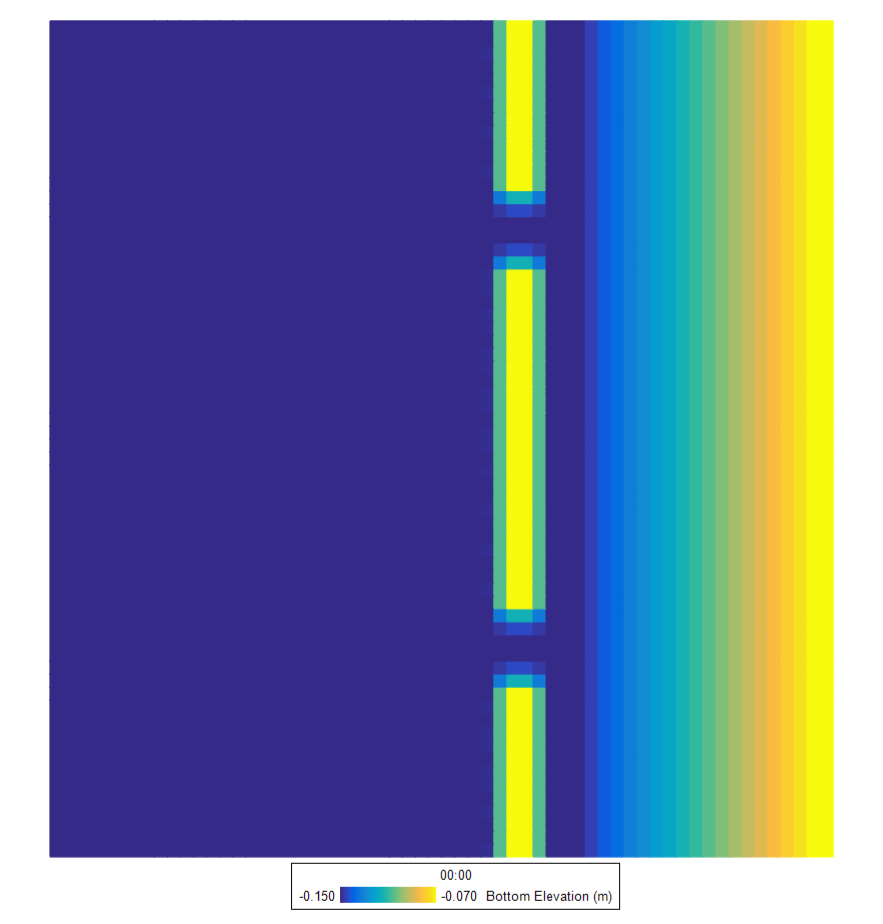
The Chapra Anti-Diffusion benchmark is used to evaluate ULTIMATE-QUICKEST against the existing upwind scheme. The test case is a 1D rectangular channel 5000 m × 10 m with a conservative tracer 100 mg/L introduced via an upstream inflow of 2 m³/s, discretized into 100 uniform cells 50 m × 10 m (Figure 2). Diffusion coefficient is set to 5 m²/s. Three model runs were conducted using three different numerical options for advective transport in EFDC+, as follows:
- Run01 – Upwind Difference
- Run02 – Upwind Difference and Anti-Diffusion Correction
- Run03 – ULTIMATE-QUICKEST

Figure 3a compares tracer concentration at 2000 m downstream for all runs against the analytical solution. ULTIMATE–QUICKEST (Run03) and Upwind with Anti-Diffusion Correction (Run02) both closely match the analytical solution, while Upwind alone (Run01) shows notable deviations due to numerical diffusion. In EFDC+, this issue can be mitigated by enabling the Anti-Diffusion Correction option; however, this improvement comes at the cost of increased computational time.

The influence of Péclet number , which represents the relative importance of advection and diffusion, was also examined. The previous model runs use a diffusion coefficient of 5 m²/s resulting in = 1. Three additional model runs were conducted with the diffusion coefficient reduced to 1 m²/s, yielding a Péclet number = 5, indicating that advective transport becomes the dominant. Under these conditions (Figure 3b), the results indicate that the Upwind scheme with Anti-Diffusion Correction no longer matches the analytical solution, while QUICKEST maintains good agreement.
Conclusions
This blog presents the ULTIMATE–QUICKEST implementation for advective transport in EFDC+. Validated through the Chapra-diffusion test-case, the scheme effectively reduces numerical diffusion and prevents unphysical oscillations via the ULTIMATE limiter, outperforming the standard upwind scheme especially at higher Péclet numbers.
References:
Leonard, B. P. (1979). A stable and accurate convection modelling procedure based on quadratic upstream interpolation. Computer Methods in Applied Mechanics and Engineering, 19, 59.
Leonard, B. P. (1991). The ULTIMATE conservative difference scheme applied to unsteady one-dimensional advection. Computer Methods in Applied Mechanics and Engineering, 88, 17–74.