Propeller Wash Modeling
Sediment resuspension, far-field transport, and recontamination risk from vessel traffic — fully coupled in EFDC+.
The Problem: Propwash as a Source of Recontamination
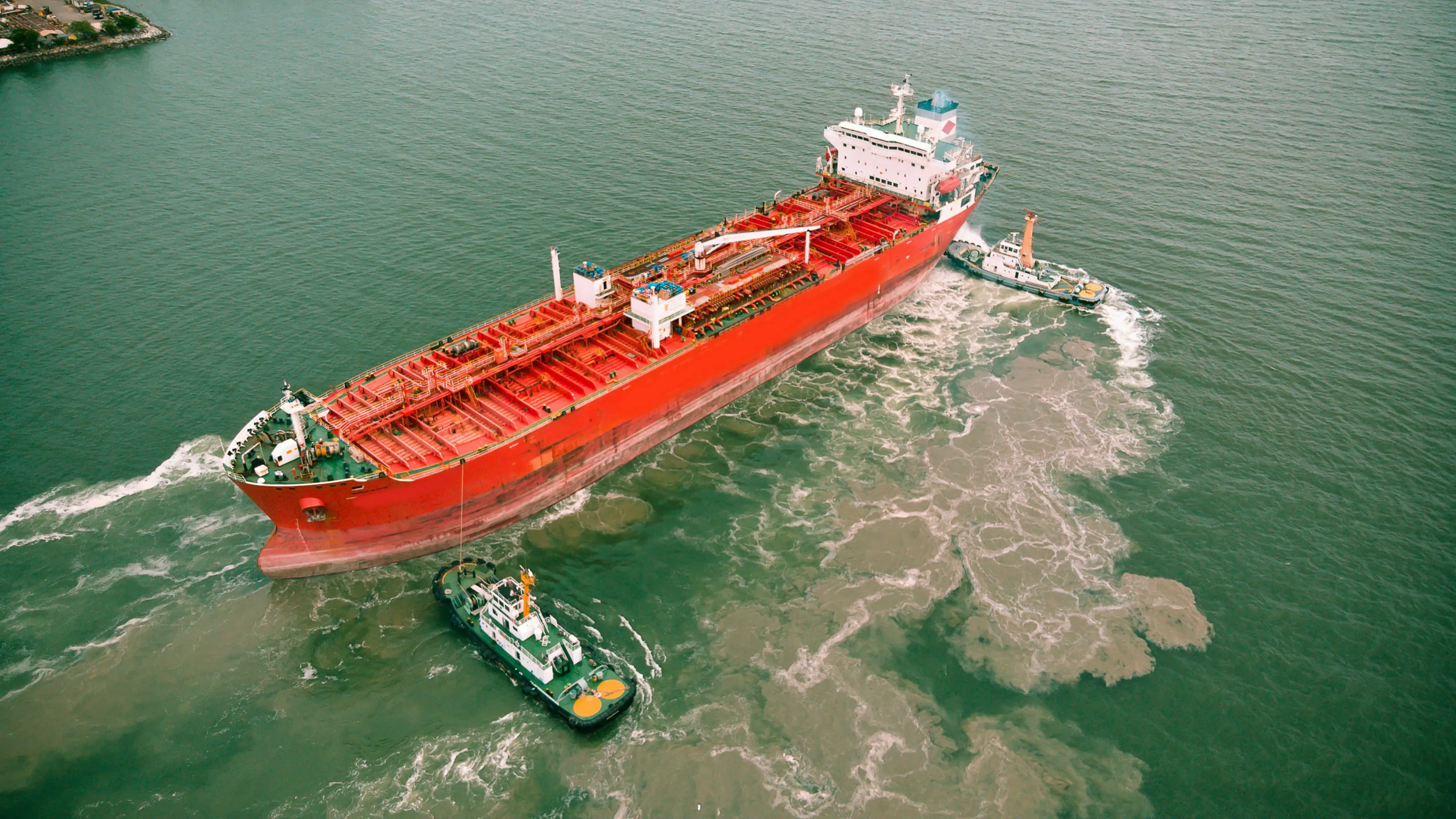
In harbors, ports, and waterways with active vessel traffic, rotating propellers generate high-velocity jet flows that can scour the sediment bed, resuspend contaminated material, and transport it to previously remediated areas. In San Diego Bay, for example, a single moored tugboat operating at low-to-moderate throttle was observed to resuspend approximately 26 tons of sediment per day at three naval piers (Wang et al. 2016).
At contaminated sediment sites undergoing dredging, capping, or in-situ treatment, propwash poses a direct threat to long-term remedy performance. Resuspended contaminants — whether metals, PCBs, PAHs, or other chemicals of concern — can travel far beyond the propeller wash jet itself, depositing at downstream locations and undermining cleanup objectives. Propwash is also a structural concern at ports and harbors, where repeated scour can compromise bulkheads, pilings, and engineered cap layers.
Despite this significance, most existing propwash methods are empirical and decoupled: they estimate bed shear stress or erosion mass from ship geometry and speed, but fail to represent the resulting momentum in the water column or its effect on far-field sediment transport. This leaves a critical gap between near-field scour predictions and realistic assessments of where contaminated sediments actually go.
The EFDC+ Solution: Fully Coupled Propwash Modeling
EFDC+ includes a purpose-built propwash module that dynamically couples the near-field propeller jet and the far-field hydrodynamic model in a single, tightly integrated simulation. Two modeling modes are available:
- Scour and resuspension only — Bed erosion and sediment resuspension are computed from propeller-induced bed shear stress, but propeller momentum is not added to the water-column flow field.
- Full momentum coupling — Propeller momentum is injected directly into the 3D flow field at each time step, driving realistic advection and vertical mixing of resuspended sediments throughout the water column.
The module ingests ship position, heading, speed, and propeller specifications — or Automatic Identification System (AIS) data for multi-vessel scenarios — and computes propwash effects dynamically at every model time step.
When full momentum coupling is active, the additional mixing energy introduced by vessel traffic can also be evaluated independently of sediment transport — for example, to assess propwash-driven disruption of water-column stratification, halocline erosion, or mixing of thermally or chemically distinct bottom layers. This makes the propwash module useful well beyond contaminated sediment applications wherever vessel-induced mixing influences water quality or stratification.
How It Works
For each ship at each time step, the algorithm:
- Generates a high-resolution subgrid behind the ship's propeller(s), at finer resolution than the main EFDC+ model grid, to resolve the jet structure.
- Computes bottom velocities across the subgrid using established propeller wash jet equations (Hamill 1987; Fuehrer & Römisch 1977; Hamill & Kee 2016), spanning three distinct flow regions:
- Efflux zone — near-propeller region where maximum velocity is approximately constant
- Zone of flow establishment — lateral mixing causes velocity to decay with dual-peak radial profile
- Zone of established flow — jet merges to single-peak Gaussian profile as it dissipates
- Calculates bed shear stress at each subgrid point using the Maynord (2000) approach.
- Computes erosion rates via the SEDZLJ formulation (Jones & Lick 2001), respecting sediment-specific critical shear stress and erosion rate parameters.
- Integrates subgrid erosion into the EFDC+ model grid as a sediment source to the bottom water layer.
- Injects propeller momentum flux into the 3D hydrodynamic flow field (when full momentum coupling is enabled), distributing momentum vertically across the water layers intersected by the propeller plane.
Efflux velocity can be specified from either propeller revolution speed (rpm) or engine power (hp), depending on available data, using Fuehrer & Römisch (1977) or Maynord (2000) respectively. For multi-propeller ships, velocities are superimposed.
Why Momentum Coupling Matters
When propeller momentum is incorporated into the flow field (full coupling mode), resuspended sediments disperse over a significantly larger area in both longitudinal and lateral directions compared to ambient-current-only simulations. Field validation at San Diego Bay demonstrated that:
- Models without momentum coupling (fp = 0) left resuspended sediments concentrated near the erosion zone, substantially underestimating plume extent.
- Models with momentum coupling (fp = 0.5) reproduced the horizontal plume distribution observed by the sampling vessel, matching measured TSS concentrations within 4 mg/L on average and 10 mg/L at maximum.
- Vertical TSS profiles matched the empirical Hong et al. (2016) distribution with Nash-Sutcliffe Efficiency values of 0.97, confirming realistic vertical mixing.
Field validation at San Diego Bay Naval Base confirmed that simulations with full momentum coupling reproduced the observed near-bed flow velocity time series within one standard deviation of measured data across all propeller speed periods, and matched measured sediment plume extents that simulations without momentum coupling substantially underpredicted.
Sensitivity analysis confirmed that maximum scour depth is most sensitive to the distance between propellers and the bed, followed by propeller speed/power. The deposition area extent is most sensitive to the momentum effect factor (fp) and propeller speed — underscoring that correct representation of propeller momentum is essential for predicting the spatial footprint of contamination redistribution.
Applications
The EFDC+ propwash module is applicable to a wide range of contaminated sediment and port/harbor engineering problems:
- Remedial Investigation / Feasibility Studies (RI/FS): Quantify propwash as a source of ongoing contamination loading and recontamination at cap or treatment areas.
- Remedial Design: Evaluate long-term stability of caps, dredge prisms, and engineered features under vessel traffic loadings.
- Litigation Support: Reconstruct historical propwash-induced sediment transport to attribute contamination sources.
- Permit and Compliance Studies: Assess turbidity and sediment resuspension impacts from vessel operations for regulatory review.
- Port and Harbor Engineering: Evaluate scour potential around pilings, bulkheads, mooring facilities, and navigation channels from routine vessel operations.
- Stratification and Water Quality: Quantify vessel-induced vertical mixing in stratified waterbodies — including disruption of haloclines, thermoclines, or density-stratified bottom layers — independent of sediment transport.
Example Studies and Presentations
- San Diego Bay, CA — US Navy tugboat field validation (Wang et al. 2016); near-bed flow velocities and bed shear stresses calibrated against ADV and PIV measurements; simulated bed shear stress and velocity reproduced across four propeller speed periods.
- San Diego Bay, CA (full-scale ship traffic) — Multi-vessel AIS-driven simulation of a cargo ship departure assisted by twin tugboats, demonstrating bay-wide propwash-induced velocity fields, bed shear stress distributions, and erosion/deposition patterns; presented at the PIANC America 2023 Conference, Fort Lauderdale, FL (Jung et al. 2023).
- Kingston Ferry Terminal, WA — Application of the coupled near/far-field propwash model to evaluate scour around a berthing facility subjected to repeated Washington State Ferry departures; simulated bed shear stresses exceeded 6 Pa at the bridge seat pilings — sufficient to mobilize gravel — consistent with observed severe and progressive scour; presented at the 2021 ASCE EWRI World Environmental & Water Resources Congress, held virtually June 7–11, 2021 (Craig et al. 2021).
- Navigation Canal, Hypersaline Mixing — Two vessels transiting in opposite directions through a 10 m deep canal with a 100 ppt hypersaline bottom layer; propeller jets break down sharp density stratification and vertically mix the water column over a single transit. Read the blog post →
Key References and Downloads
| Resource | Description |
|---|---|
| Craig et al. (2023) — Journal of Hydraulic Engineering | Peer-reviewed paper describing the fully coupled EFDC+ propwash methodology, field validation, and sensitivity analysis. |
| Jung et al. (2023) — PIANC America 2023 Conference | Conference presentation: propeller wash model applied to multi-vessel AIS-driven ship traffic simulation in San Diego Bay. |
| Craig et al. (2021) — ASCE EWRI Congress (virtual) | Conference presentation: dynamically coupled near/far-field propwash scour model applied to the Kingston Ferry Terminal, WA. |
| EFDC+ Propwash White Paper (2021) | Detailed technical documentation of the EFDC+ propwash implementation. |
| EFDC+ Theory Document | Full theoretical basis for EFDC+ hydrodynamics, sediment transport, and propwash. |
| EFDC+ Source Code (GitHub) | Open-source EFDC+ code including the propwash module. |
| Wang et al. (2016) — ESTCP ER-201031 | Field study of propwash-induced flow velocities and bed disturbance at DoD harbors, used for model validation. |
The EFDC+ propwash module is open-source and freely available. See the EFDC+ Explorer Modeling System for pre- and post-processing tools, and the Knowledge Base for user guidance on setting up propwash simulations.