Propeller Wash Impacts
Quantifying propeller-induced hydrodynamics — bed shear stress, flow velocities, water-column mixing, and structural impacts — fully coupled in EFDC+.
The Problem: Propwash as a Hydrodynamic Force
When a ship's propeller rotates, it generates a high-velocity jet that propagates aft and downward, imposing significant forces on the surrounding water and the structures and seabed below. In busy ports, harbors, navigation channels, and ferry terminals, these jets are a recurring and cumulative source of hydraulic loading that conventional hydrodynamic models do not capture.
The consequences span a wide range of engineering concerns. At the seabed, propeller jets produce bed shear stresses far exceeding those from tides or currents alone — sufficient to mobilize coarse sediments and gravels, undercut pilings, and migrate scour holes toward critical infrastructure. At berthing structures, repeated propwash exposure degrades the seabed beneath bridge seats, dolphins, and aprons, compromising foundation stability over time. In stratified or thermally layered water bodies, propeller momentum can erode density interfaces and drive vertical mixing that alters water quality and temperature distribution throughout the water column.
Despite the significance of these effects, most modeling approaches treat propwash empirically or in isolation — estimating bed shear from static ship parameters without representing the resulting three-dimensional flow field or its interaction with the surrounding hydrodynamic environment.
The EFDC+ Solution: Fully Coupled Propwash Modeling
EFDC+ includes a purpose-built propwash module that dynamically couples the near-field propeller jet to the far-field 3D hydrodynamic simulation at every model time step. Two modeling modes are available:
- Bed shear and scour only — Propeller-induced bottom velocities and bed shear stresses are computed at high resolution across a subgrid behind each vessel, without adding propeller momentum to the water-column flow field.
- Full momentum coupling — Propeller momentum flux is injected directly into the 3D flow field, driving realistic far-field currents, turbulent mixing, and vertical transport throughout the water column.
The module ingests ship position, heading, speed, and propeller specifications — or Automatic Identification System (AIS) data for multi-vessel, real-traffic scenarios — and updates propwash effects dynamically at every model time step.
How It Works
For each ship at each time step, the algorithm:
- Generates a high-resolution subgrid behind the ship's propeller(s), at finer resolution than the main EFDC+ model grid, to resolve the near-field jet structure.
- Computes bottom velocities across the subgrid using established propeller wash jet equations (Hamill 1987; Fuehrer & Römisch 1977; Hamill & Kee 2016), spanning three distinct flow regions:
- Efflux zone — near-propeller region where maximum velocity is approximately constant
- Zone of flow establishment — lateral mixing causes velocity to decay with a dual-peak radial profile
- Zone of established flow — jet merges to a single-peak Gaussian profile as it dissipates into the ambient flow
- Calculates bed shear stress at each subgrid point using the Maynord (2000) approach, resolving the spatial distribution of hydraulic loading on the seabed.
- Computes erosion rates where bed shear stress exceeds sediment-specific critical thresholds (when sediment transport is activated).
- Injects propeller momentum flux into the 3D hydrodynamic flow field (when full momentum coupling is enabled), distributed vertically across the water layers intersected by the propeller plane.
Efflux velocity can be specified from either propeller revolution speed (rpm) or engine power (hp), depending on data availability. For multi-propeller vessels, velocities are superimposed. Applied power can be varied along a vessel track to reflect operational phases such as berthing, departure, transit, and towing.
Why Full Momentum Coupling Matters
Bed shear stress alone does not describe the full hydrodynamic impact of propwash. The propeller jet also introduces a substantial momentum flux into the water column that drives currents well beyond the immediate scour zone, influences mixing across the full water depth, and interacts with ambient tidal and wave-driven flows.
When propeller momentum is incorporated into the flow field, EFDC+ predicts:
- Far-field current velocities driven by propeller energy, propagating hundreds of meters beyond the vessel track.
- Vertical mixing through the water column, including erosion of density stratification — haloclines, thermoclines, or chemically distinct bottom layers — that would not be captured by bed shear calculations alone.
- Realistic turbulence structure using the Smagorinsky horizontal turbulence closure and Mellor-Yamada vertical turbulence model, consistent with the full EFDC+ hydrodynamic framework.
Applications
The EFDC+ propwash module addresses a broad range of port, harbor, and waterway engineering problems:
- Berthing Structure Scour Assessment: Predict bed shear stress and scour potential at pilings, bridge seats, dolphins, aprons, and bulkheads from routine vessel arrivals, departures, and maneuvering.
- Navigation Channel Design: Evaluate propwash-induced bed velocities and scour depths along channels serving large vessels or high-frequency ferry traffic.
- Terminal Safety and Maintenance Planning: Quantify cumulative propwash loading from vessel traffic to inform dredging schedules, scour protection design, and structural inspection intervals.
- Port Master Planning: Assess propwash impacts from proposed vessel classes or traffic patterns prior to infrastructure investment.
- Water-Column Mixing Studies: Evaluate propeller-driven vertical mixing in stratified waterbodies — including disruption of haloclines, thermoclines, or density-stratified bottom layers — independent of sediment transport.
- Contaminated Sediment Sites: Quantify propwash as a source of bed disturbance, sediment resuspension, and recontamination at remediated or capped areas.
- Permit and Compliance Studies: Assess turbidity, flow velocity, and bed disturbance impacts from vessel operations for regulatory and environmental review.
Example Studies and Presentations
- San Diego Bay, CA — US Navy tugboat field validation (Wang et al. 2016); near-bed flow velocities and bed shear stresses calibrated against ADV and PIV measurements; simulated bed shear stress and velocity reproduced across four propeller speed periods.
- San Diego Bay, CA (full-scale ship traffic) — Multi-vessel AIS-driven simulation of a cargo ship departure assisted by twin tugboats, demonstrating bay-wide propwash-induced velocity fields, bed shear stress distributions, and erosion/deposition patterns; presented at the PIANC America 2023 Conference, Fort Lauderdale, FL (Jung et al. 2023).
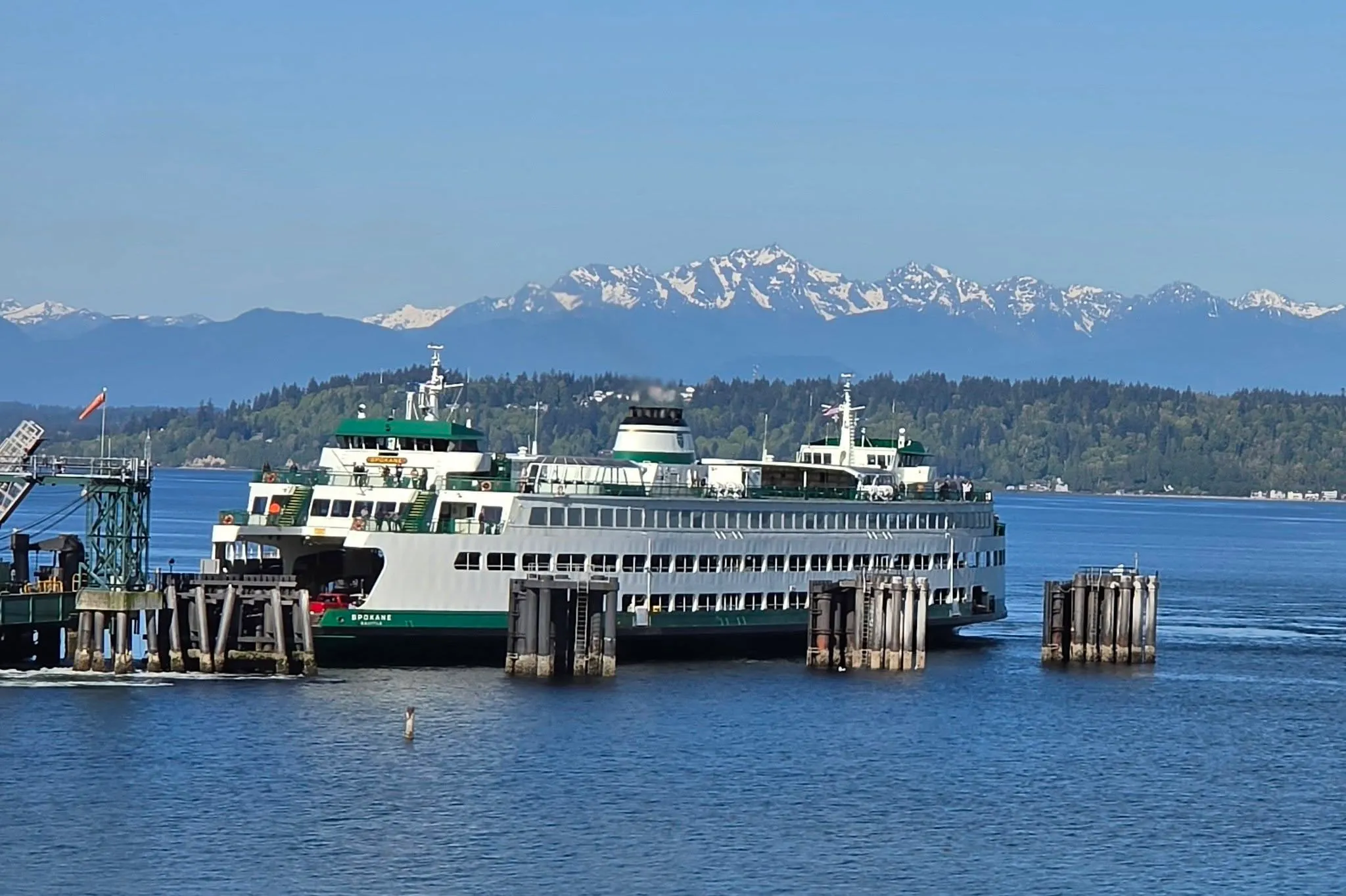
- Kingston Ferry Terminal, WA — Application of the coupled near/far-field propwash model to evaluate scour around a berthing facility subjected to repeated Washington State Ferry departures; simulated bed shear stresses exceeded 6 Pa at the bridge seat pilings — sufficient to mobilize gravel — consistent with observed severe and progressive scour; presented at the 2021 ASCE EWRI World Environmental & Water Resources Congress, held virtually June 7–11, 2021 (Craig et al. 2021).
- Navigation Canal, Hypersaline Mixing — Two vessels transiting in opposite directions through a 10 m deep canal with a 100 ppt hypersaline bottom layer; propeller jets break down sharp density stratification and vertically mix the water column over a single transit. Read the blog post →
Key References and Downloads
| Resource | Description |
|---|---|
| Craig et al. (2023) — Journal of Hydraulic Engineering | Peer-reviewed paper describing the fully coupled EFDC+ propwash methodology, field validation, and sensitivity analysis. |
| Jung et al. (2023) — PIANC America 2023 Conference | Conference presentation: propeller wash model applied to multi-vessel AIS-driven ship traffic simulation in San Diego Bay. |
| Craig et al. (2021) — ASCE EWRI Congress (virtual) | Conference presentation: dynamically coupled near/far-field propwash scour model applied to the Kingston Ferry Terminal, WA. |
| EFDC+ Propwash White Paper (2021) | Detailed technical documentation of the EFDC+ propwash implementation. |
| EFDC+ Theory Document | Full theoretical basis for EFDC+ hydrodynamics, sediment transport, and propwash. |
| EFDC+ Source Code (GitHub) | Open-source EFDC+ code including the propwash module. |
| Wang et al. (2016) — ESTCP ER-201031 | Field study of propwash-induced flow velocities and bed disturbance at DoD harbors, used for model validation. |
The EFDC+ propwash module is open-source and freely available. See the EFDC+ Explorer Modeling System for pre- and post-processing tools, and the Knowledge Base for user guidance on setting up propwash simulations.