EFDC+
Chemical Fate and Transport
What EFDC+ adds to the legacy EFDC code
Convention: [EFDC+] marks a capability not present in the legacy EPA/GVC code.
In many parts of the world, pesticides, heavy metals, PAHs, PCBs, and other toxic substances in surface waters and sediments are a serious concern. EFDC+ supports sophisticated modeling of both organic and metallic compounds, with the improved accuracy of 3D transport fields in a highly accurate numerical transport scheme. EFDC+ provides you the tools to determine the long-term and short-term concentration distributions of these substances in the waterbody and sediment bed.
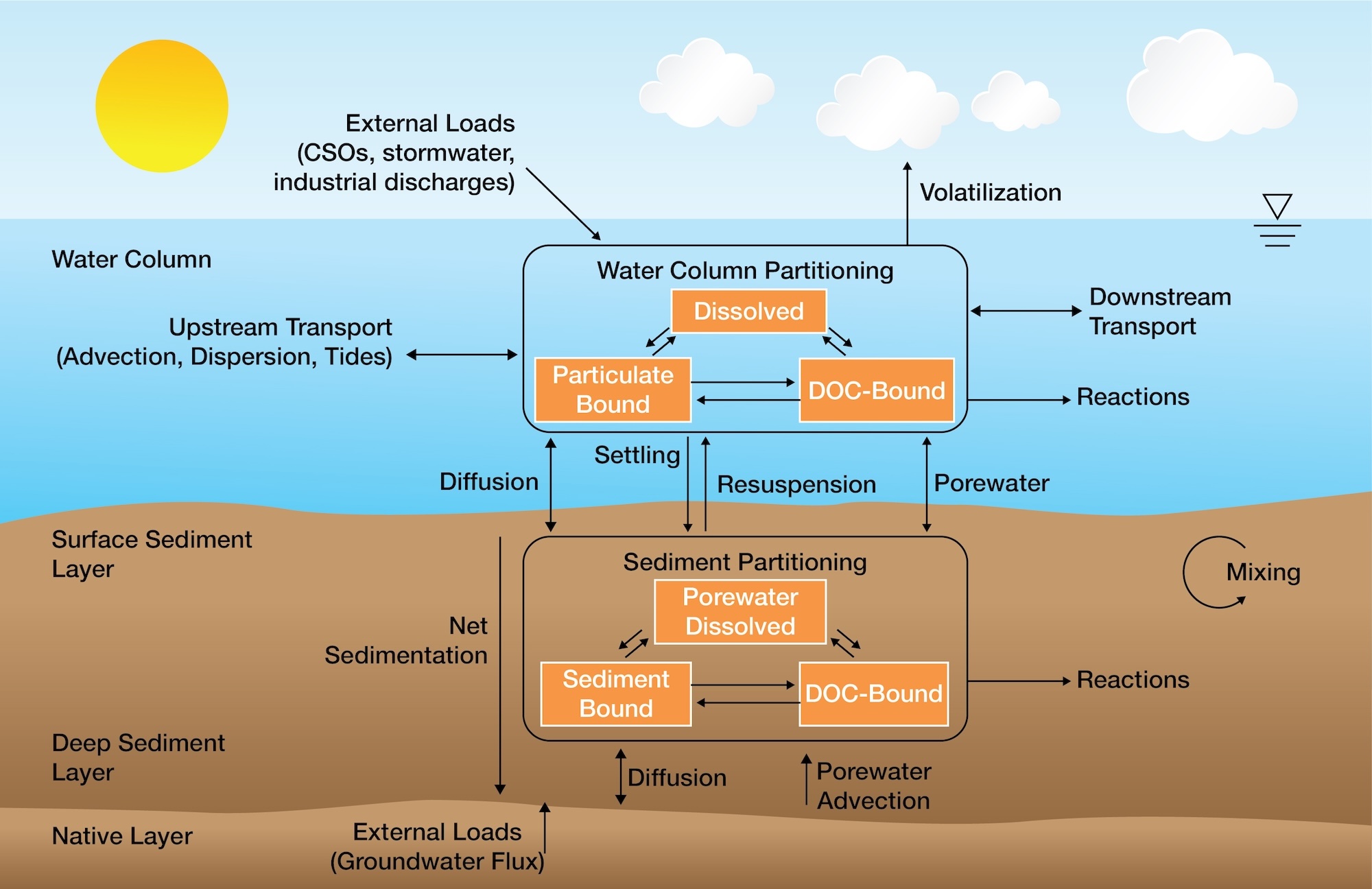
Figure 1 — Chemical fate and transport in EFDC
What EFDC+ Adds
| Capability | Legacy EFDC (EPA/GVC) | EFDC+ |
|---|---|---|
| Partitioning approach | One approach applied to every chemical | Chosen per chemical — 1-, 2-, or 3-phase |
| Partition coefficients | Uniform across the domain | Spatially varying, cell by cell, in water column and bed |
| Porewater | Limited bed representation | Advection and diffusion within the bed |
| Sediment coupling | Original sediment module | Original module or SEDZLJ, with measured erosion data |
| Bedload transport of toxics | Not available | Available in both sediment modules |
| Coupling | Linkage files between models | Single coupled model, no interface files |
Single Coupled Model
EFDC+ provides a fully coupled simulation for toxics modeling, which simplifies the model’s construction, calibration, and scenario analyses. Hydrodynamics, sediment transport, and chemical fate run together, so a chemical always moves on the flow field and the sediment field that produced it. With no interface files to generate and manage, linkage file errors are reduced. Historically, coupled models have been criticized as too slow, but with EFDC+’s multi-threaded capability, this criticism no longer applies.
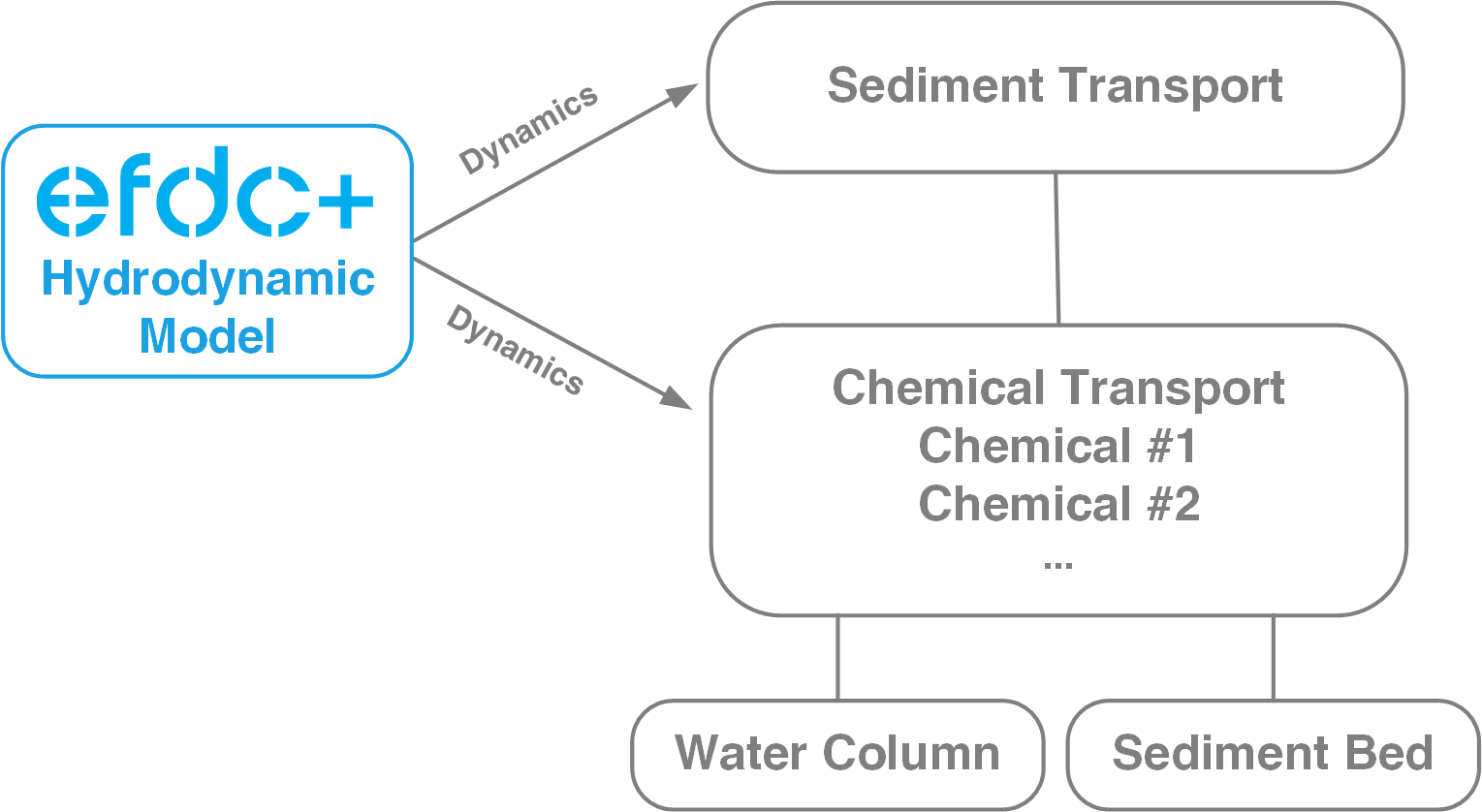
Figure 2 — Hydrodynamics, sediment transport, and any number of chemicals are solved together in one model, each chemical tracked through both the water column and the sediment bed.
Contaminant Partitioning
There’s no limit to the number of toxic substances you can simulate at once, and each one can individually use 1-, 2-, or 3-phase partitioning with optional organic carbon specification. Sorption follows a Langmuir isotherm under equilibrium partitioning, distributing each chemical between the dissolved phase, material effectively dissolved in the water, and the suspended sediment particles it sorbs to.
[EFDC+] That per-chemical flexibility is a DSI addition. Before 2015, multiple partitioning options existed but a single approach had to be applied to every chemical in a simulation.
[EFDC+] Partition coefficients can also vary spatially. Rather than one value for the whole domain, coefficients can be specified cell by cell for both the water column and the sediment bed, which matters on sites where sediment character, organic carbon content, or source history changes across the study area.
Sediment Bed and Porewater
[EFDC+] The bed is not a passive sink. EFDC+ resolves settling, deposition, and resuspension between the water column and the bed, together with porewater advection and diffusion within the bed itself, so chemicals can migrate through the sediment column and re-enter the water even when the bed is not eroding. Bed layers track sorbed and dissolved concentrations independently.
SEDZLJ Toxics Model
[EFDC+] Developed by Sandia National Laboratory, SEDZLJ is an improvement on previous models because it directly incorporates site-specific erosion rate and shear stress data, while maintaining a physically consistent, unified treatment of bedload and suspended load. EFDC+ has extended the sediment transport capability of the SEDZLJ model with EFDC+’s robust toxics model.
Decay and Other Losses
Bulk degradation applies a first-order decay rate in the water column, the sediment bed, or both, and in the bed you can limit it to a maximum sediment depth, so decay stops below the biologically active zone.
Biodegradation represents breakdown by bacterial enzyme systems, available in both the water column and the bed.
Volatilization moves dissolved chemicals across the air-water interface, driven by the gradient between dissolved and atmospheric concentration and by conductivity across that interface, a function of molecular weight and Henry’s Law constant, plus wind, current, and depth.
Non-Cohesive Bedload Transport
You can simulate toxics transport by bedload as well as suspended load, in both the original sediment transport module and SEDZLJ.